1. Infrastructure, Terminology, Standards and Product Lines
Introduction
Benefits of IP Infrastructure
Transitioning from baseband infrastructure to an IP-based environment requires investment, planning, training and new equipment. The benefits gained from this transition offer a compelling long-term direction for modern broadcast facilities. IP networks simplify signal distribution by replacing large quantities of dedicated cabling and distribution amplifiers with a shared network infrastructure capable of transporting many signals simultaneously. Media streams can be routed flexibly using multicast rather than physical patching, allowing sources to be distributed to multiple destinations without additional hardware. Synchronisation is maintained using Precision Time Protocol (PTP), ensuring that video, audio and ANC (ancillary) data remain accurately aligned across the facility.
IP-based broadcast infrastructure:
- Reduces the cabling volume and physical I/O footprint when compared to a similar baseband system
- Reduces the requirement for substantial Black Burst/Tri-Level reference DA infrastructure
- Provides the technical (software-based) and commercial (Lawo Flex) models to dynamically increase and decrease system capacity based on operational demands
- Provides greater flexibility, scalability and operational efficiency while maintaining the reliable and predictable behaviour professional broadcast and media productions require
EBU Waves of IP Adoption
The European Broadcasting Union (EBU) describes the broadcast industry’s transition to IP-based production as occurring in two distinct waves.
Wave 1 – IP Infrastructure
The first wave focused on replacing SDI transport with IP networking. Broadcasters adopted commercial off-the-shelf (COTS) Ethernet switches and standards such as SMPTE ST 2110 and SMPTE ST 2059 to transport and synchronise professional media over managed IP networks. While the underlying transport technology changed, many workflows and operational models remained similar to those used in traditional SDI facilities.
Wave 2 – Software-Defined Media Facilities
The second wave represents a shift from dedicated broadcast hardware to software-based media facilities. Media signals can be transported, processed, and managed as software services running on standard compute infrastructure, enabling cloud-native workflows, resource sharing, automation, and the dynamic allocation of processing resources. This allows broadcast facilities to operate more like modern datacentres while providing greater flexibility and scalability.
Terminology
To begin a journey towards IP, it can be helpful to reinforce some basics, understand some new terminology and introduce certain Lawo product lines.
Media Gateways / Stageboxes
In an IP-based environment, a media gateway device is used to convert signals between traditional baseband formats and IP media streams. Gateway devices allow legacy broadcast equipment, such as cameras, replay servers, routers, vision mixers/video switchers, audio consoles, etc., to integrate with an IP-based infrastructure. They typically perform conversion between formats such as:
- SDI to IP video, audio and ANC data streams
- Analogue, AES or MADI to IP audio streams
This allows facilities to migrate to IP gradually while continuing to use existing baseband equipment.
Media stageboxes are gateway devices that primarily focus on input/output (I/O) conversion to bring signals into and out of the network. Stageboxes are typically deployed in locations such as stages, commentary areas and in remote production environments. They provide physical connections for audio and video in a variety of formats with an emphasis on portability and low noise emission.
| Lawo Video Gateway |
|---|
| .edge |
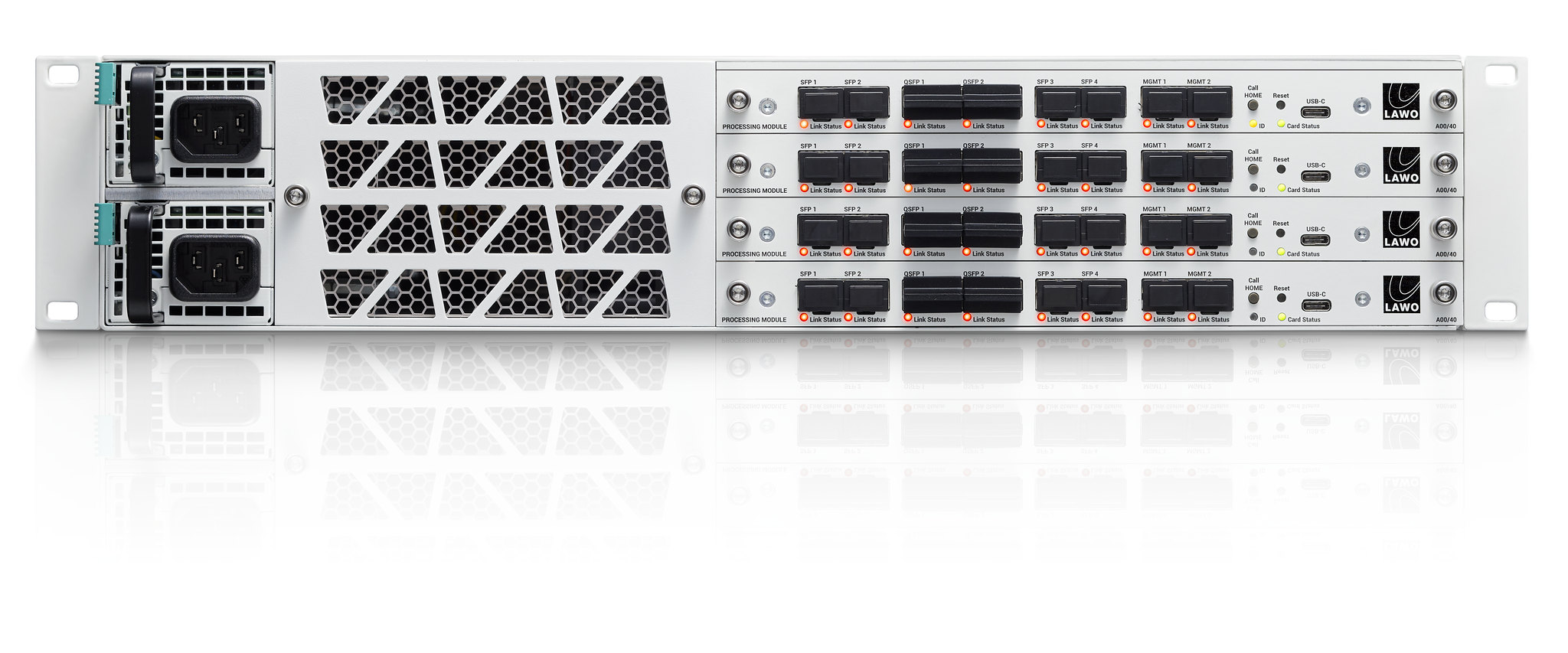
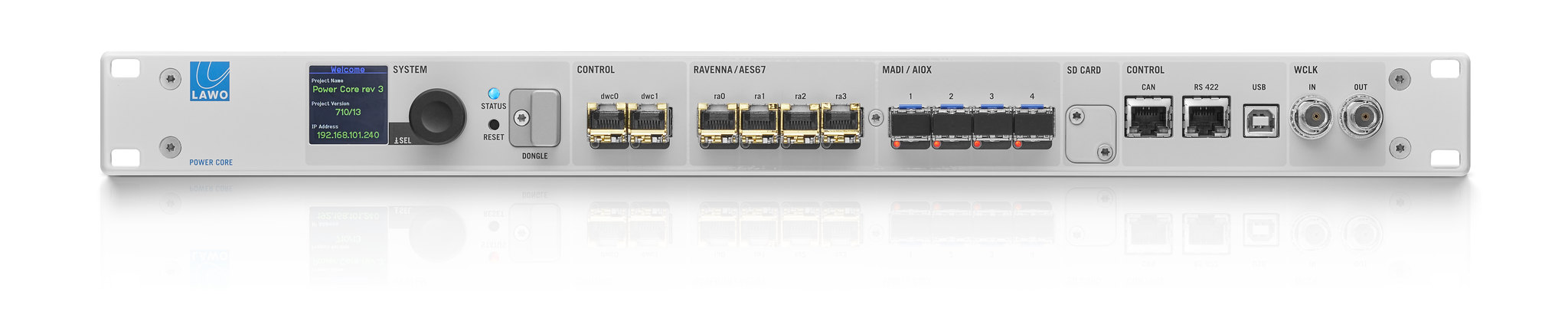
| Lawo Audio Gateways |
|---|
| Power Core |
| Lawo AV Stagebox |
|---|
| Edge One |

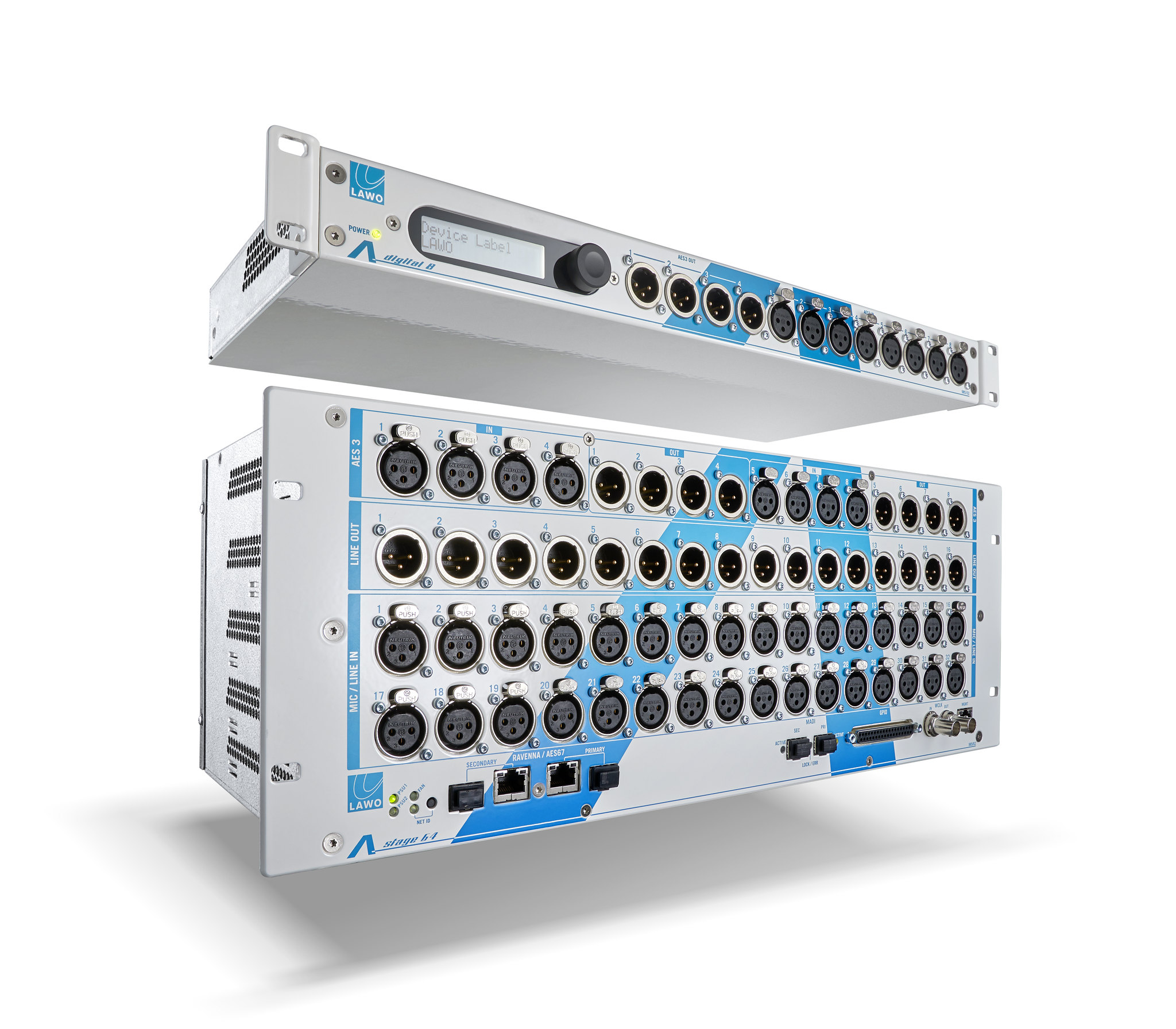
| Lawo Audio Stageboxes |
|---|
| A__line |
Inputs/Outputs vs Senders/Receivers
In a traditional baseband system, signals are usually described in terms of inputs and outputs. For example:
- Input - receives a signal into a device
- Output - transmits a signal from a device
In IP-based systems, the terminology changes slightly because signals are transmitted as network streams rather than via individual physical connections. Instead of input and outputs, IP devices tend to use the terms:
- Sender - a device that transmits a media stream onto the network (TX)
- Receiver - a device that subscribes to and receives a media stream (RX)
Senders can create multicast streams that can be received by multiple receivers on the network. This model allows one source to be delivered to many destinations without requiring additional distribution hardware (e.g. distribution amplifiers). For engineers familiar with baseband systems, the relationship can be thought of as:
| Baseband Term | IP / ST 2110 Term |
|---|---|
| Output | Sender |
| Input | Receiver |
| Distribution Amplifier | Multicast stream |
Senders and Receivers are logical media endpoints, rather than devices. A single device can expose multiple senders and receivers.
- This shift in terminology reflects a key architectural change: instead of connecting devices with dedicated cables, IP-based devices exchange media streams across a network.
Multicast
In an IP-based system, media streams are typically distributed using multicast. A multicast stream is created by a sender, which places a single copy of a media flow onto the network. Multiple receivers can then subscribe to that stream and receive it simultaneously. This is fundamentally different from traditional baseband routing, where distributing one signal to multiple destinations would require a distribution amplifier (DA), or a router, and would utilise multiple physical outputs. With multicast, the network itself handles this distribution efficiently, meaning:
- One sender → many receivers
- No duplication of the stream at the source
- No additional hardware required for splitting signals
In standards like SMPTE ST 2110, multicast enables scalable and flexible routing, allowing any authorised receiver to 'connect' to a stream as needed, which is similar to selecting a TV channel. In simple terms, multicast replaces the concept of a DA or baseband router outputs with a network-based distribution model, making it much easier to share signals across large and dynamic systems. To put multicast into context in terms of network traffic:
- Unicast: one sender, one receiver
- A separate stream is created for each destination, which consumes unnecessary bandwidth if the same signal is needed multiple times
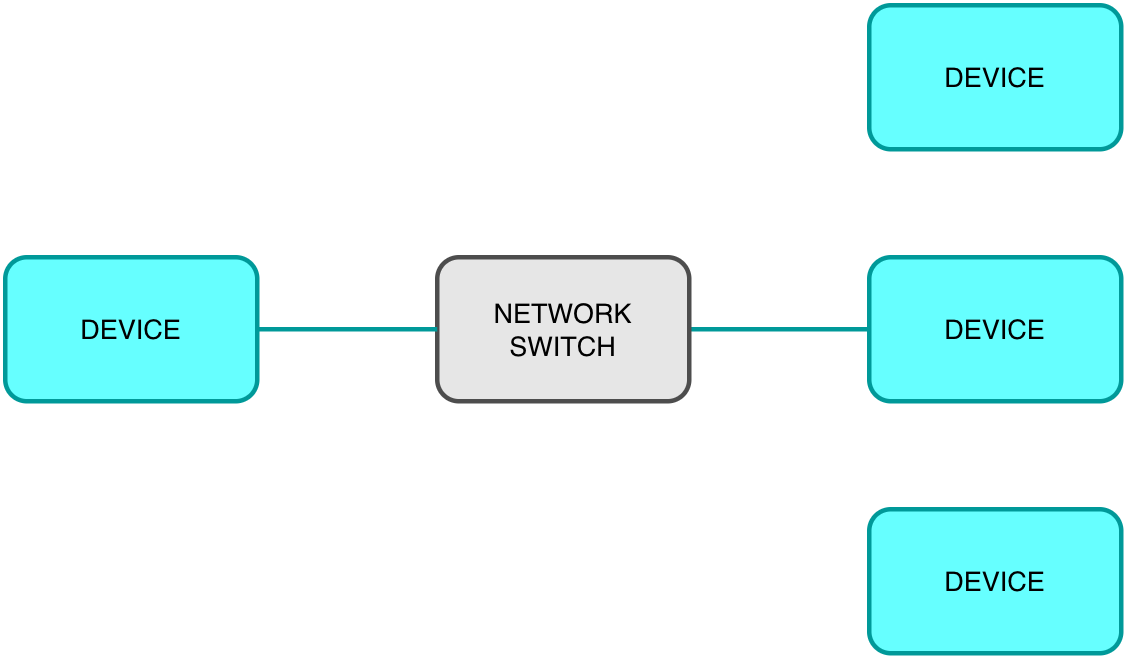
- Multicast: one sender, multiple receivers (on demand)
- A single stream is sent, and only devices that subscribe receive it – this is the model used in ST 2110 systems
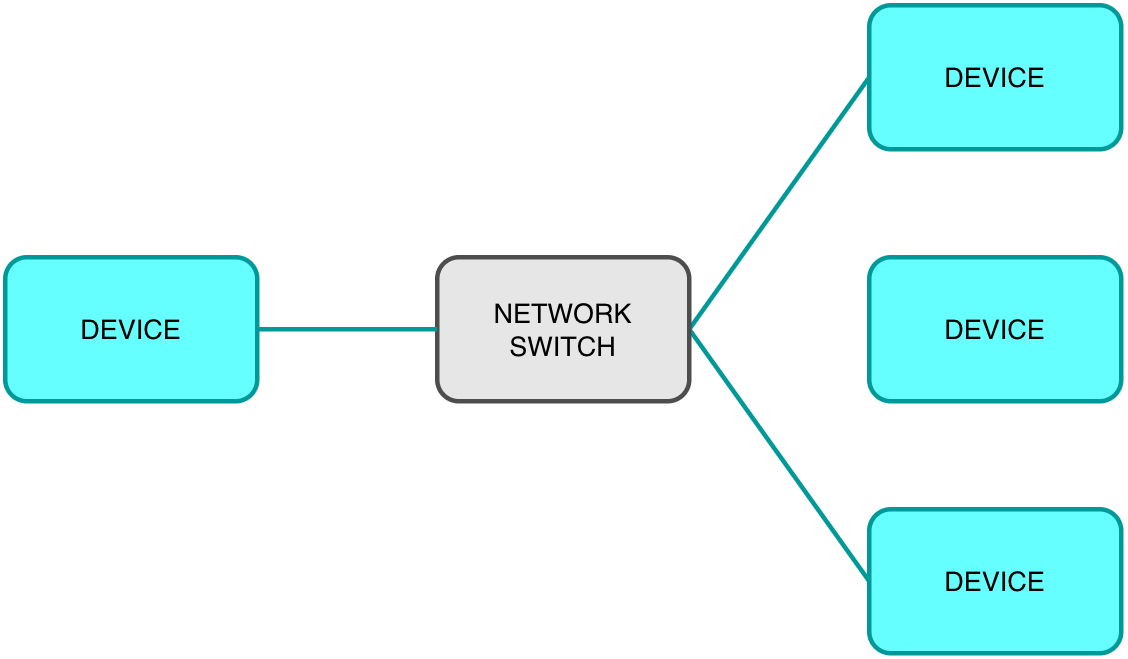
- Broadcast: one sender, all devices on the same network
- The stream is received everywhere, regardless of whether devices need it. This is inefficient and generally avoided for professional media networks.
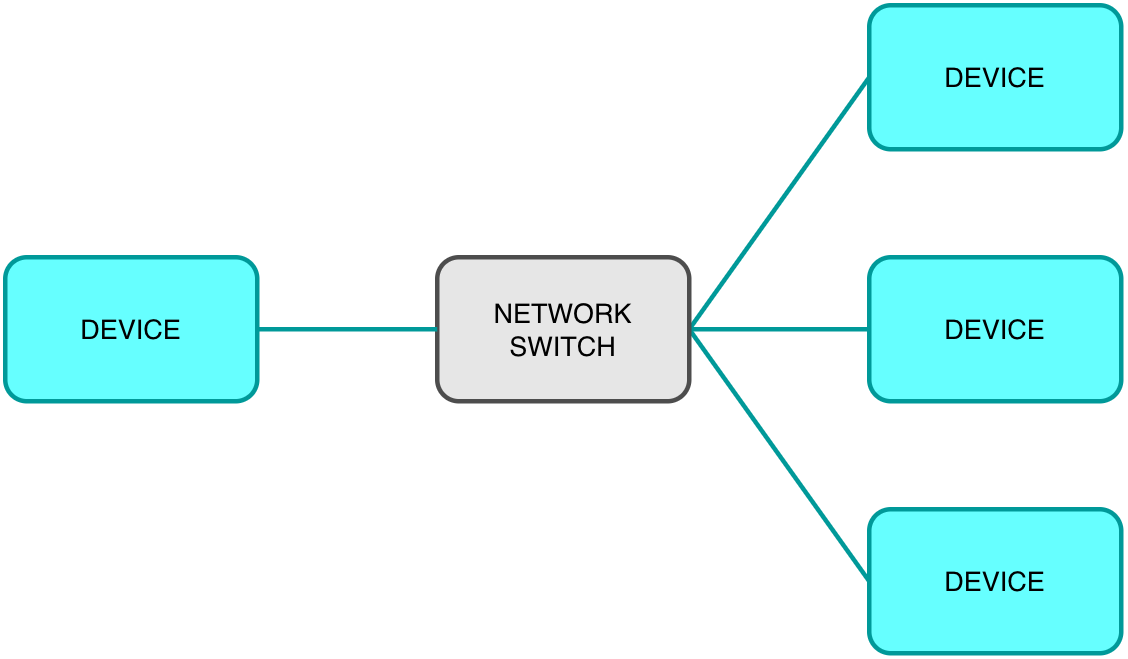
Multicast combines the efficiency of transmitting a single stream with the flexibility of delivering it to multiple interested receivers, without requiring the sender to generate a separate copy of the stream for every destination.
AES67 / RAVENNA
The transition to ST 2110 did not begin with video. It began with Audio over IP (AoIP). Long before broadcasters started replacing SDI infrastructures, audio manufacturers were already transporting professional audio across Ethernet networks. Technologies such as RAVENNA and Dante demonstrated that high-quality, low-latency audio could be transported reliably over standard IP networks using multicast distribution and Precision Time Protocol (PTP) synchronisation.
One challenge with these early AoIP systems was interoperability. Although many used similar underlying technologies, devices from different manufacturers could not always exchange audio streams directly. To address this, the Audio Engineering Society (AES) published the AES67 standard in 2013. AES67 is not a complete audio networking solution; rather, it defines a common interoperability layer that allows compliant AoIP systems to exchange audio streams using standardised RTP transport, multicast networking and PTP synchronisation. RAVENNA was already built around these open networking principles and naturally aligned with AES67. As a result, RAVENNA became one of the key technologies demonstrating that professional media could be transported reliably across managed IP networks.
ST 2022-6
At roughly the same time, the broadcast industry began exploring methods of transporting SDI signals over IP networks. This led to the development of SMPTE ST 2022-6, which effectively encapsulated an entire SDI signal—including video, embedded audio and ANC data—into an IP stream. From an engineering perspective, ST 2022-6 allowed broadcasters to replace SDI cables with IP networks while preserving familiar SDI workflows.
Although ST 2022-6 proved that uncompressed professional media could be transported reliably over IP, it retained many of the limitations of SDI. Audio, video and ANC data remained bundled together as a single signal, requiring devices to receive and de-embed the entire stream even if only one essence was required.
ST 2022-7
As broadcasters moved from SDI to IP, reliability remained a critical requirement. SMPTE ST 2022-7 introduced Seamless Protection Switching (SPS), a redundancy mechanism that sends duplicate media streams across two 'active-active' independent network paths. A receiver continuously compares packets arriving on both paths and automatically selects the correct packet if one path experiences loss or failure. As both streams are received simultaneously, this protection switching is effectively seamless and invisible to operators.
Although ST 2022-7 originated within the ST 2022 family of standards, it is widely used alongside ST 2110 and has become the de-facto redundancy model for professional ST 2110 facilities. Today, when engineers refer to a “RED” and “BLUE” network architecture, they are typically describing an ST 2022-7 design.
Seamless protection switching relies on the receiver obtaining at least one valid copy of each packet from either network path. The receiver must also be capable of accommodating differences in packet arrival times between the two paths (known as path differential delay). If packets are lost on both paths, or arrive outside the receiver’s supported timing window, uninterrupted media delivery cannot be guaranteed.
ST 2110
The industry’s next step was SMPTE ST 2110. Rather than transporting a complete SDI signal, ST 2110 separates video, audio and ancillary data into independent RTP streams, allowing each essence to be routed, processed and managed individually. This approach provides significantly greater flexibility and efficiency for modern broadcast production workflows.
Importantly for Lawo and RAVENNA users, ST 2110 did not invent a new method for transporting audio. Instead, SMPTE ST 2110-30 directly references AES67 and adopts many of the networking concepts already proven by RAVENNA and other AoIP technologies. This means that many of the principles used in modern ST 2110 facilities—RTP transport, multicast distribution and PTP synchronisation—were already familiar to audio engineers working with RAVENNA systems years before ST 2110 emerged.
Key Standards in the Evolution of Broadcast IP Standards
| Audio over IP | AES67 | ST 2022-6 | ST 2022-7 | ST 2110 | Modern IP Media Facilities | |||||
|---|---|---|---|---|---|---|---|---|---|---|
| RAVENNA, Dante etc. | Audio interoperability | SDI transported over IP | Seamless redundancy for IP media | Separate video, audio, and ANC essences | ST 2110 + ST 2022-7 + NMOS |
Real-Time Transport Protocol (RTP)
ST 2110 streams are transported through a network using RTP, which is designed specifically for real-time media transport such as audio and video. IP allows media data to be divided into 'packets' that can be transmitted across an IP network while maintaining the correct signal order and timing information. Each RTP packet contains two important pieces of information:
- Sequence number
- Timestamp
The sequence number increases by one for every packet that is transmitted. This allows the receiving device to determine whether packets have arrived in the correct order, or whether any packets have been lost during transmission. For example:
If a sender transmits:
Packet 1001
Packet 1002
Packet 1003
Packet 1004
But the receiver observes:
Packet 1001
Packet 1002
Packet 1004
It can immediately detect that packet 1003 is missing. RTP timestamps provide additional timing information that allows receivers to correctly reconstruct media samples and gain synchronisation with a global system reference clock (PTP).
Device Network Interfaces
Unlike baseband devices that typically use BNC-style connectors for SDI or MADI, for example, IP-enabled broadcast devices usually have multiple network interfaces, each serving a specific purpose. These commonly include:
- Control interfaces - typically used for configuration and monitoring
- Broadcast Control devices tend to have control network interfaces only - e.g. a hardware routing panel
- Streaming Media interfaces - typically used for carrying ST 2110 RTP streams
- Streaming Media devices tend to have redundant streaming interfaces that connect into the RED and BLUE Streaming Media networks. Control interfaces are optional.
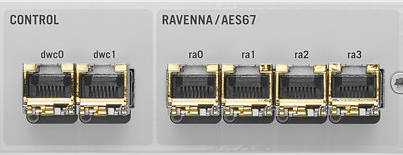
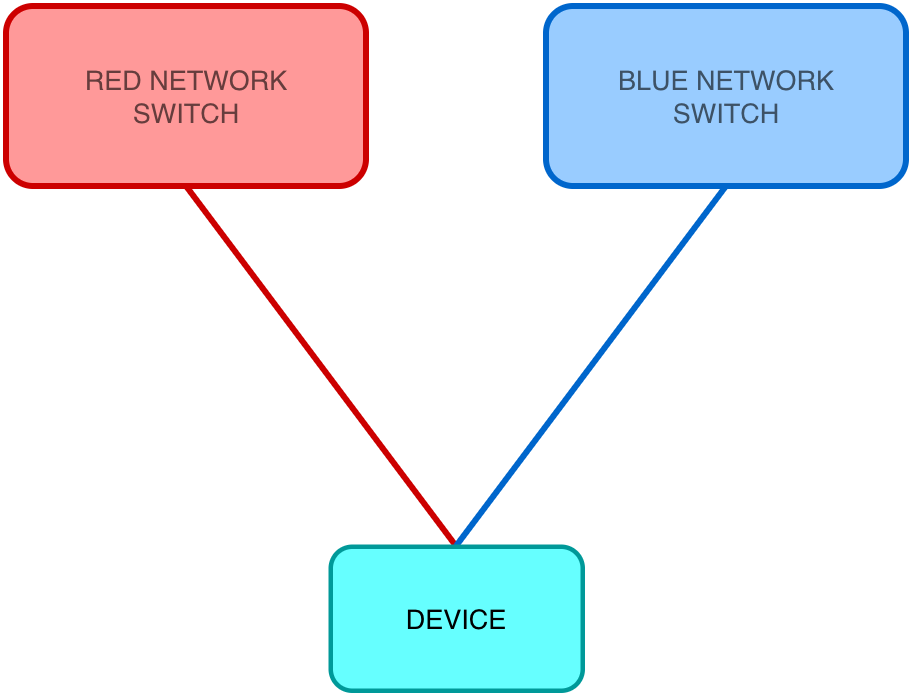
In a typical ST 2022-7 design, Streaming Media networks are separated into two independent network 'fabrics':
- RED network
- BLUE network
Fabric is a term used to describe an overall architecture of interconnected switches and devices that work together to exchange data across a network.
The main advantage is resilience in the event of failures. If a switch, link, power supply, or entire network path fails on one fabric, the other fabric continues carrying the media without interruption. Because receivers are already receiving both streams simultaneously, failover is effectively seamless, avoiding visible video glitches, audio pops, or frame loss that would be unacceptable in live broadcast environments. Dual fabrics also allow maintenance and upgrades to be performed on one network while services continue running on the other. To achieve absolute redundancy, the two fabrics should be physically and logically independent, using separate switches, links, and power sources so that a single fault cannot affect both networks at the same time.
Devices with full ST 2022-7 redundancy have at least two Streaming Media interfaces – one connected to the RED fabric and one connected to BLUE fabric:
Routing Media in IP Networks
In traditional baseband facilities, signal routing is typically performed by a centralised router to which all sources and destinations must be physically connected. In an IP-based environment, this function is replaced by Streaming Media network switches, which transport ST 2110 streams across the network. Unlike a fixed baseband router chassis, switches can be deployed in both centralised and distributed architectures, allowing capacity to grow simply by adding additional network links or switches as requirements increase. This dynamic scalability not only simplifies system expansion but also enables more flexible production models, including geographically distributed facilities and remote production workflows, where media can be transported between locations without requiring all equipment to be physically co-located.
Processing Media in IP Networks
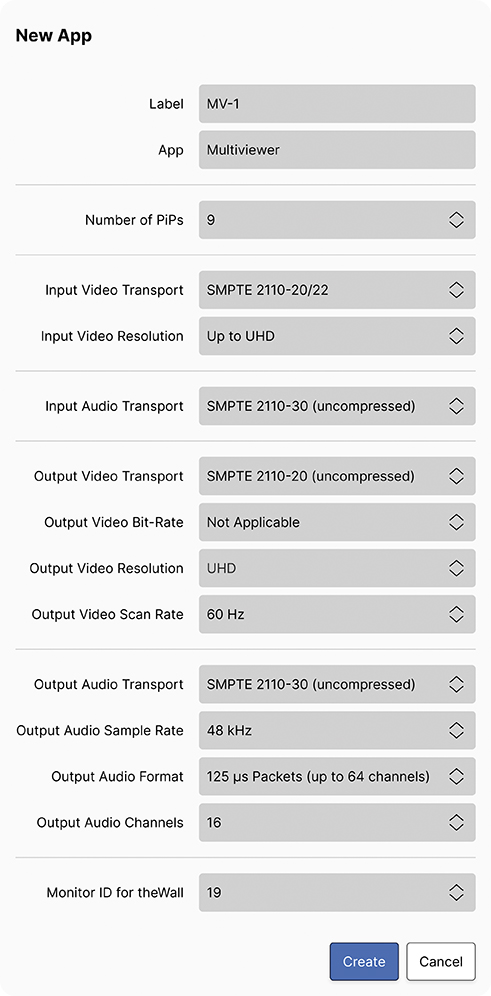
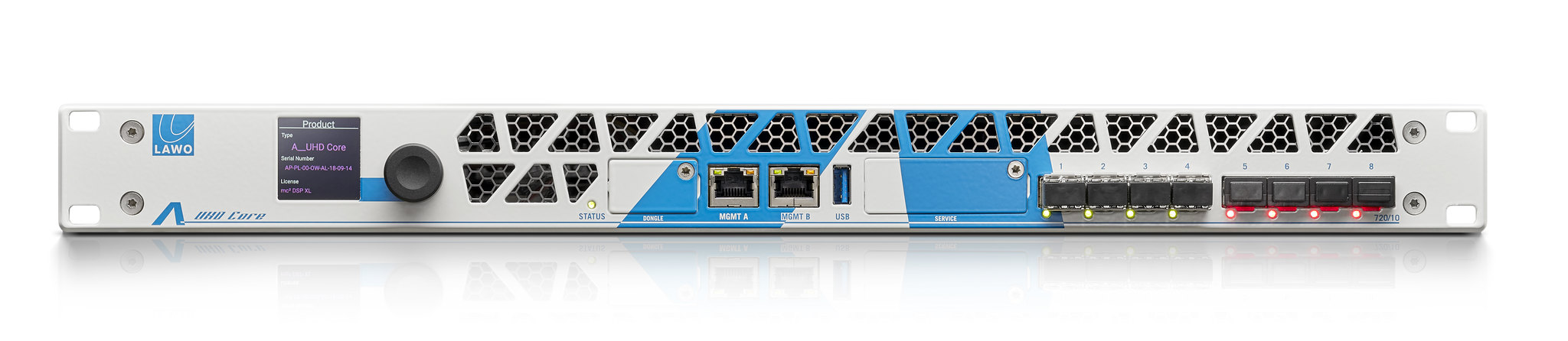
An important advantage of IP systems is that they remove the traditional requirement for co-location of I/O, signal processing and control equipment. In baseband environments, devices often need to be physically located close to one another due to cabling limitations (e.g. maximum transmission distance). In an IP environment, media signals can be transported anywhere across the network, allowing I/O devices to be placed where they are operationally convenient, while processing resources can be centralised or distributed as needed. This enables more flexible and scalable system designs, where capacity can dynamically increase and decrease with operational requirements. Platforms such as HOME Apps, A__UHD Core and Power Core illustrate this approach, allowing signal processing to be deployed as modular services rather than fixed-function hardware.
| Lawo AV Processing | Lawo Audio Processing |
|---|---|
| HOME Apps | A__UHD Core |
| Power Core (RP) |
IP Device Management
In an IP-based media environment, a platform or application is required to register, configure and manage devices on the network. This role is performed by HOME, Lawo's core management platform for IP infrastructures. HOME maintains an inventory of connected devices, allows streams and devices to be configured and also performs basic signal routing. By acting as the central management layer, HOME enables devices, applications and control systems to work together within a unified IP environment.
| Lawo IP Device Management |
|---|
| HOME |

Broadcast Control
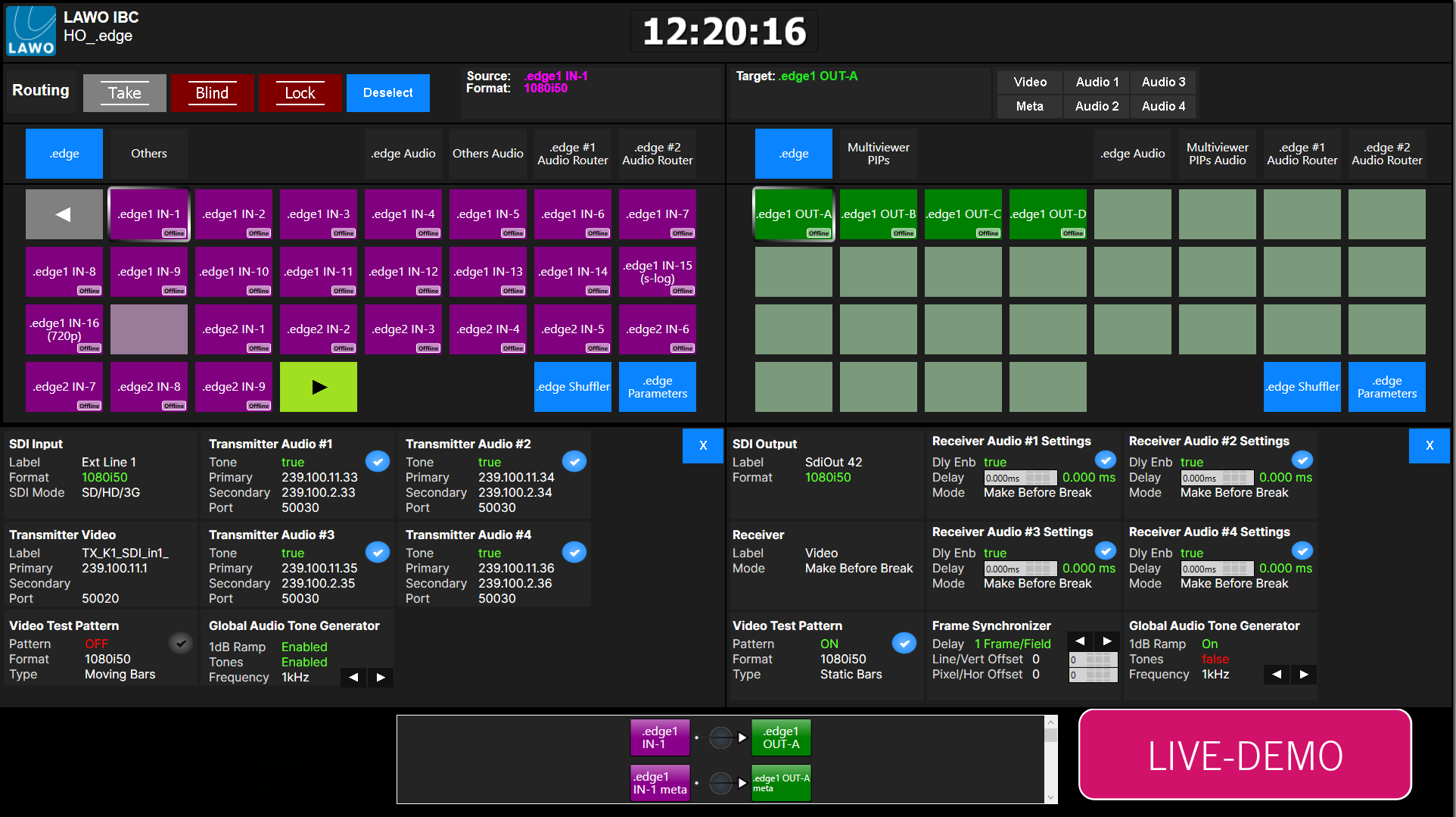
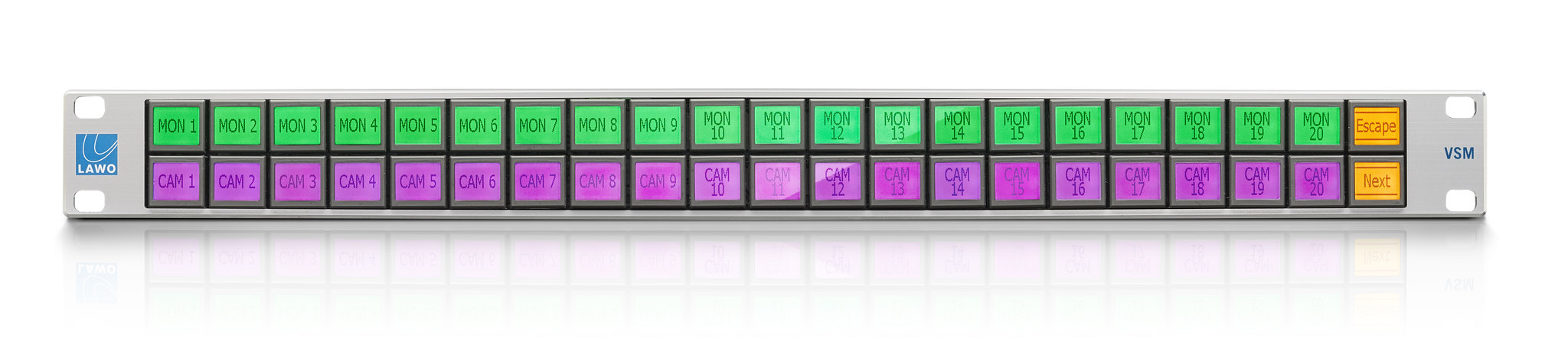
While IP networks provide the infrastructure to transport and process media signals, a broadcast control system is required to coordinate devices and translate the technical capability into practical broadcast workflows. The controller connects to both baseband and network-enabled equipment such as gateways, processing devices and control interfaces, allowing engineers and operators to perform actions like routing signals or adjusting device parameters. In this way, the broadcast controller ties together the network-accessible I/O, processing and device control so that the infrastructure operates according to the broadcaster's operational workflow and business logic. Lawo provides this capability through VSM (Virtual Studio Manager), which acts as the central control application for managing complex multi-vendor media environments.
| Lawo Broadcast Controller |
|---|
| VSM |
The Bigger Picture
The benefits of an IP infrastructure extend beyond replacing traditional baseband transport. As discussed earlier, the EBU describes the industry’s transition to IP production as occurring in two waves. The first wave focused on replacing SDI transport with open-standards-based IP networking and commercial off-the-shelf (COTS) switching infrastructure. This established the foundation required to transport professional media using standards such as SMPTE ST 2110 and SMPTE ST 2059. The second wave builds on this foundation by enabling media processing functions to operate as software services running on standard COTS compute platforms rather than dedicated broadcast appliances. Functions that were traditionally implemented using specialised hardware can increasingly be deployed as software applications, virtual machines or containers.
This shift provides significant technical and commercial advantages. Broadcasters can benefit from ongoing investment in the wider IT industry, where processing performance, efficiency and scalability continue to improve through routine hardware refresh cycles. As a result, capacity can be expanded more dynamically, resources can be shared more efficiently, and facilities can be designed with greater operational flexibility. Because IP-based infrastructure is packet-based and standards-driven, systems can also scale more easily by increasing network bandwidth, adding switching capacity or deploying additional compute resources. This makes facilities more adaptable and better aligned with modern datacentre architectures, enabling technologies and workflows such as:
- Virtualisation
- Containerisation (for example, Docker)
- Remote and distributed production
- Cloud-based media processing
- Integration and signal hand-off with non-traditional broadcasters and Content Delivery Networks (CDNs)
By combining IP networking, software-defined processing and open standards, modern broadcast facilities are becoming increasingly aligned with datacentre architectures while continuing to meet the reliability and performance requirements of professional media production. This enables new workflows such as remote production, resource virtualisation and cloud-based media processing while positioning facilities to take advantage of future developments in compute and networking technologies.
Lawo provides products that integrate across the entire IP media environment—from signal I/O and media processing to device management and broadcast control. These technologies allow customers and integration partners to design and build solutions tailored to their specific operational requirements, whether that means a small production environment, a large broadcast facility or a geographically distributed production workflow. By supporting open standards such as ST 2110, ST 2022-7, RAVENNA, AES67 and NMOS (explained in Chapter 3), Lawo solutions are designed to function within multi-vendor environments while providing powerful native capabilities for media processing, routing, orchestration and system management.
Lawo Professional Services
Ultimately, every broadcast facility has different technical requirements, operational workflows and scale. Lawo's product portfolio provides the building blocks that enable these systems to be assembled in a flexible and scalable way. To support customers and partners throughout this process, Lawo's Professional Services team provides consultation, system design guidance, project delivery and operational support to help translate technical requirements into practical, reliable systems. This approach ensures that IP-based media infrastructures are deployed confidently and operate successfully over the long term. These services are a keystone in Lawo's ability to provide customers with solutions rather than just a collection of hardware and software. Together, Lawo's technologies and services enable broadcasters, media companies and system integrators to build IP-based production environments that meet their current needs while remaining adaptable for the future.
In the next chapter about the role and functions of the Streaming Media networks, we will explain how converted baseband IP packets are synchronised (via PTP), transported and distributed through the network.